At a glance
- Selenium is a trace mineral that is part of the structure of 25 human selenoproteins; these proteins play a role in thyroid hormone metabolism and in protection against oxidative damage.
- The range between requirement and upper limit is relatively narrow: the NIH reference is 55 µg (RDA) and the upper limit is 400 µg; EFSA set the upper limit at 255 µg in 2023.
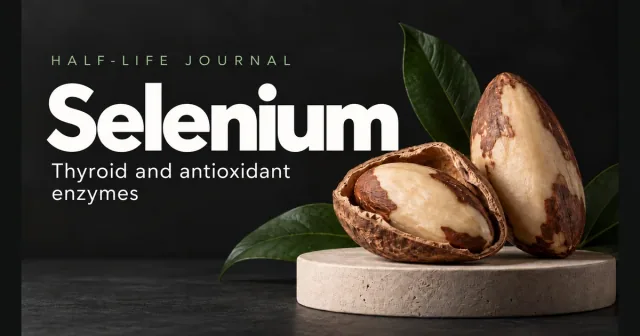
- The amount in food depends on the soil; a single Brazil nut can exceed the daily reference.
- Deficiency (such as Keshan disease) is seen in certain regions; in healthy, adequately nourished people, additional selenium has not been shown to reduce cancer or cardiovascular disease.
- A decrease in antibodies has been reported in thyroid autoimmunity; clinical benefit is not certain.
- This guide does not recommend personal doses.
What is selenium and what does it do in the body?
Selenium is an essential mineral the body needs in small amounts. The NIH reports that selenium is a component of 25 selenoproteins, including glutathione peroxidases and thioredoxin reductases; that selenoproteins play important roles in thyroid hormone metabolism, DNA synthesis, reproduction, and protection against oxidative damage and infection. The concentration of selenium in the body is highest in the thyroid gland; selenoproteins take part in the conversion of the prohormone T4 to active T3 and help protect the gland from the hydrogen peroxide produced during thyroid hormone synthesis. About 28–46% of the body’s selenium is in skeletal muscle. [1]
A mineral’s role in these functions does not mean that intake above an adequate level would perform the same functions better. EFSA accepted the intake at which plasma selenoprotein P level plateaus as the criterion of adequacy; in its assessment of observational and randomized studies, it found no evidence of an additional benefit associated with selenium beyond the intake required for this plateau. [2]
Forms in food and measuring status
According to the NIH, selenium in food is found mainly as selenomethionine and in part as selenocysteine; plants convert inorganic selenite and selenate in the soil into these organic forms. Dietary selenium is easily absorbed and absorption is largely unaffected by selenium status. Status is usually measured by plasma or serum selenium; the NIH reports that 8 µg/dL and above in healthy people is generally considered adequate. Hair and toenail selenium reflect intake over months to years; glutathione peroxidase 3 and selenoprotein P are functional markers but can be affected by inflammation. [1]
How much selenium is needed daily?
The US Food and Nutrition Board value (RDA) reported by the NIH is 55 µg per day in men and women over 14; 60 µg in pregnancy and 70 µg in lactation. [1] EFSA, in its 2014 opinion, found data insufficient to derive an average requirement and set an adequate intake (AI) of 70 µg per day for adults; the same value applies in pregnancy, and 85 µg in breastfeeding women. [2] These two values belong to different organizations and different methods; one is called “RDA,” the other “adequate intake.”
The NIH reports that average selenium intake in the US is 108 µg/day from food and beverages and 116 µg/day from food and supplements (in the US, 132 µg from food in adult men and 94 µg in women). Most people take in an adequate amount; 17–19% of adults use a supplement containing selenium. [1]
In pregnancy and lactation, the NIH and EFSA values are as above; in addition, selenium supplementation in pregnant women who are TPO antibody positive is debated, and the American Thyroid Association gave a weak recommendation against it in 2017 (detailed in the thyroid section).
What is the upper limit of selenium, and why is excess harmful?
Selenium is one of the minerals for which the gap between requirement and toxic level is narrow. The NIH reports the tolerable upper intake level (UL) for selenium as 400 µg per day in adults; this limit is based on amounts that cause brittleness and loss of hair and nails and does not apply to people taking selenium under a physician’s supervision. [1] EFSA’s 2023 opinion, on the other hand, took hair loss as the critical endpoint, determined a lowest observed adverse effect level (LOAEL, 330 µg/day) from the SELECT study, and, with an uncertainty factor of 1.3, set the UL for adults (including pregnant and breastfeeding women) at 255 µg per day. [3]
| Organization | Lower reference | Upper limit (adult) |
|---|---|---|
| NIH / US Food and Nutrition Board | RDA 55 µg/day [1] | UL 400 µg/day [1] |
| EFSA | AI 70 µg/day (2014) [2] | UL 255 µg/day (2023) [3] |
Chronic excess intake is called selenosis. According to the NIH, early symptoms are garlic odor on the breath and a metallic taste in the mouth; the most common clinical findings are hair loss and brittleness or loss of nails. Skin rash, nausea, diarrhea, fatigue, irritability, and nervous system abnormalities have also been reported. Acute poisoning has occurred with incorrectly formulated products: in 2008, 201 people using a liquid supplement containing 200 times the amount of selenium stated on the label had serious adverse reactions. [1] EFSA states that adult consumers are unlikely to exceed the UL; the exception is people who regularly use food supplements with high daily doses and people who regularly eat Brazil nuts. [3]
Which foods contain it, and why does it vary from region to region?
According to the NIH, protein-rich foods (seafood, meat, poultry, organ meats) are the best sources; Brazil nuts contain a very high amount. Selenium in plant foods varies greatly from region to region according to the selenium content of the soil; in animal products the difference is smaller because animals maintain their tissue levels through homeostatic mechanisms. In Brazil nuts, 68–91 µg of selenium per nut can be found, and regular consumption can lead to poisoning. [1] The serving table and foods such as soy, bread, and fish are on a separate page.
Detailed guideWhich foods contain selenium? Serving table, Brazil nuts, and the effect of soilWho gets selenium deficiency?
The NIH reports that selenium deficiency alone rarely causes disease; that in certain communities it can trigger pictures such as Keshan and Kashin-Beck disease; and that deficiency can worsen iodine deficiency and increase the risk of congenital hypothyroidism in infants (iodine deficiency is covered on a separate page). Keshan disease is an endemic cardiomyopathy described in 1935 in some regions of China with selenium-poor soils; in these regions the average intake of adults was at most 10 µg per day, and at least 20 µg/day is stated to be needed to prevent the disease. After intervention studies with selenite supplements in the 1970s–1990s, incidence fell markedly. [1]
Among groups at risk of low intake are people living in selenium-poor regions, long-term hemodialysis patients, and people living with HIV; the NIH also reports that average intake is low in some European countries, especially among vegans. [1] According to the NIH, deficiency is very rare in the US and Canada.
Selenium status in Türkiye
The available measurement for Türkiye is old and from a single city. In the measurement by Hincal and colleagues in 218 healthy people in Ankara, mean serum selenium in adults aged 18–48 was 74 ± 16 µg/L; the authors considered this within a safe and adequate range. Relative to the 8 µg/dL (80 µg/L) threshold the NIH considers adequate, this mean is somewhat lower; however, direct comparison is limited because of differences in method and year. [8] These data are dated 1994 and cannot be generalized beyond Ankara.
Does a selenium supplement prevent cancer?
No; large randomized trials did not support this. In SELECT, 35,533 men (aged 50 and over in African Americans, 55 and over in others; PSA ≤4 ng/mL) received 200 µg of selenium per day (L-selenomethionine), vitamin E, or both, or placebo; median follow-up was 5.46 years. For prostate cancer, HR 1.04 (99% CI 0.87–1.24) was found in the selenium group; there was no significant difference in other cancer endpoints either. A statistically nonsignificant increase in type 2 diabetes (RR 1.07; 99% CI 0.94–1.22; P=0.16) was also reported. [4] According to the NIH, the study was stopped after 5.5 years because no difference in prostate cancer risk was seen. [1]
In a later case-cohort analysis of SELECT (1,739 men with prostate cancer, 3,117 controls), selenium supplementation was ineffective in men with low baseline selenium status; in those with high baseline levels (toenail selenium at the 60th percentile and above), it increased the risk of high-grade prostate cancer by 91% (P=0.007). The authors conclude that men should avoid selenium supplementation beyond the recommended intake. This is a subgroup analysis, not the study’s prespecified main result. [5]
The NIH reports that the 2018 Cochrane review (83 studies; 27,232 participants in 10 randomized trials, 94% men) found that 200–500 µg of selenium per day, mostly as selenomethionine, for 2–10.3 years had little or no effect on cancer incidence or death. [1]
Does selenium reduce the risk of cardiovascular disease?
The NIH reports that observational studies have given conflicting results between low selenium status and cardiovascular disease, and that clinical trial evidence does not support reducing the risk of cardiovascular disease with selenium supplementation, especially in people who get adequate selenium from their diet. In SELECT, evaluated as a secondary endpoint, 200 µg of selenium per day in 17,488 well-nourished men did not change the risk of cardiovascular events over 7–12 years of follow-up; a Cochrane review combining SELECT and 11 small studies (100–800 µg per day; 19,715 participants, mostly men) also found no reduction in fatal and nonfatal cardiovascular events. [1]
Does selenium work in thyroid diseases?
Hashimoto’s thyroiditis. The 2024 meta-analysis by Huwiler and colleagues included 35 unique studies from randomized trials. In patients not receiving thyroid hormone replacement, selenium lowered TSH (SMD −0.21; 95% CI −0.43 to −0.02; 7 cohorts, 869 participants). TPO antibody fell both in those receiving and not receiving replacement (SMD −0.96; 29 cohorts, 2,358 participants), but heterogeneity was high (I² 90%). There was no significant change in fT4, fT3, TGAb, and thyroid volume; side effects were similar between groups. The authors rated overall certainty as moderate. [7] The NIH, for its part, reports that another review examining nine controlled studies giving selenium alone (679 participants, mostly women) found no effect on TSH, ultrasound findings, and quality of life and that the authors concluded the evidence does not support the use of selenium; in seven of the nine studies in this review reporting levels, participants’ baseline selenium status was deficient or borderline. [1] A decrease in antibodies is a laboratory marker; it does not show that the patient’s complaints or disease course improved.
Mild Graves orbitopathy. In the double-blind study by Marcocci and colleagues, 159 patients with mild Graves orbitopathy received 100 µg of selenium twice daily, pentoxifylline, or placebo for 6 months. At month 6, selenium improved quality of life, reduced eye involvement, and slowed progression of the disease compared with placebo; exploratory evaluations at month 12 confirmed this. This is a single study and covers only mild orbitopathy. [6]
The NIH also reports that the American Thyroid Association in 2017 gave a weak recommendation against selenium supplementation in pregnant women who are TPO antibody positive. [1]
Drug interactions and label reading
The NIH reports that selenium supplements can interact with some medicines; for example, cisplatin can lower hair and serum selenium, but the clinical importance of this is unknown. [1] In supplements, selenomethionine, selenium-enriched yeast, sodium selenite, and sodium selenate are used; most multivitamin products contain 55 µg, whereas products containing only selenium may contain 100–400 µg. [1] The amount on the label is in µg; in comparing with the upper limit, selenium from food and from more than one product is counted together. This guide does not recommend products or brands.
Common misunderstandings about selenium
- “Selenium strengthens immunity, the more the better.” Selenoproteins have a role in immunity; however, the upper limit is narrow and no additional benefit has been shown in people with adequate status. [1] [2]
- “Brazil nuts are a harmless snack.” The NIH reports that a nut can contain 68–91 µg and can cause toxicity with regular consumption. [1]
- “Selenium prevents hair loss.” Hair loss is in fact the most common clinical finding of selenium excess. [1]
Evidence table: claim, population and limits
| Claim | Population examined | Result and limit |
|---|---|---|
| Protection from Keshan disease | Selenium-poor regions in China | Incidence fell after intervention studies; valid only for regions of very low intake. [1] |
| Cancer prevention | SELECT, 35,533 men; Cochrane, 27,232 participants | No benefit; increase in high-grade prostate cancer in men with high baseline selenium. [4] [5] |
| Hashimoto’s, TPO antibody | 29 cohorts, 2,358 participants | Antibody decrease (SMD −0.96), I² 90%; clinical benefit unclear. [7] |
| Mild Graves orbitopathy | 159 patients, single RCT | Improvement in quality of life and eye involvement. [6] |
| Upper limit | NIH and EFSA | NIH 400 µg (based on hair and nail effects); EFSA 255 µg (based on the LOAEL in SELECT and an uncertainty factor). [1] [3] |
This guide does not recommend a daily or weekly personal dose. For people with thyroid disease, pregnant women, kidney patients, and people using a high-dose product, the selenium decision is made with the treating physician.
What does the evidence say?
What it does and does not affectLimited or insufficient evidence
- CMild Graves orbitopathy (single RCT)In a double-blind study of 159 patients, 6 months of selenium improved quality of life and eye involvement compared with placebo; it is a single study covering only mild orbitopathy.
- CHashimoto's — TPO antibody decrease (laboratory marker)In the meta-analysis TPO antibody fell (SMD −0.96) but heterogeneity was high (I² 90%); clinical benefit on symptoms and disease course is unclear.
No benefit shown
- ECancer preventionno benefit shownIn SELECT (35,533 men), 200 µg selenium did not reduce prostate cancer; in men with high baseline selenium, the risk of high-grade prostate cancer increased.
- ECardiovascular diseaseno benefit shownNo reduction in cardiovascular events was found in 17,488 well-nourished men in SELECT or in the Cochrane review combining SELECT with 11 small studies.
What do the A–E grades mean?
The letter describes the strength of evidence for a specific claim, not the size of the benefit or a usage recommendation. E does not mean ineffectiveness has been proven.
- AStrong
- Established physiology (e.g. correcting a deficiency) or strong, consistent, direct human studies
- BModerate
- Supportive human evidence; small effect or some limitations
- CLimited
- A single randomised trial, mixed results or low-certainty human findings
- DInsufficient
- Small, uncontrolled or indirect evidence; not enough to judge
- ENo benefit shown / not studied in humans
- No benefit shown for the claim, or only animal or cell data exist
These grades are Half-Life Journal’s editorial evidence summary; they are not a formal GRADE rating or independent medical approval.
The letter shows evidence strength; it is not a score for positive effect or a usage recommendation.
Frequently asked questions
What is selenium for?
Selenium is part of the structure of 25 human selenoproteins; these proteins play a role in thyroid hormone metabolism and in protection against oxidative damage. Function is impaired in deficiency, but additional selenium has not been shown to prevent a disease in people with adequate status.
How much selenium should be taken per day?
The US RDA reported by the NIH is 55 µg per day for ages over 14 (60 in pregnancy, 70 µg in lactation). EFSA has set an adequate intake of 70 µg per day for adults. This guide does not recommend personal doses.
Is excess selenium harmful?
Yes. The NIH reports the upper limit as 400 µg per day in adults; EFSA set 255 µg in 2023. In chronic excess, hair loss, nail brittleness, garlic odor on the breath, and a metallic taste can be seen.
How many Brazil nuts can be eaten per day?
A single nut can contain 68–91 µg of selenium and the amount varies greatly; this alone can exceed the daily reference. The NIH draws attention to the risk of toxicity with regular consumption. No personal number of nuts is recommended.
Does selenium prevent cancer?
It did not in large randomized trials. In SELECT, 200 µg of selenium per day in 35,533 men did not reduce prostate cancer; in a later analysis, the risk of high-grade prostate cancer increased in those with high baseline selenium.
Sources
- Guideline / review NIH Office of Dietary Supplements — Selenium: Health Professional Fact Sheet (2025)Back to text ↑
- Institution EFSA NDA Panel — Scientific Opinion on Dietary Reference Values for selenium (EFSA Journal) (2014)Back to text ↑
- Institution EFSA NDA Panel — Scientific opinion on the tolerable upper intake level for selenium (EFSA Journal) (2023)Back to text ↑
- RCT Effect of selenium and vitamin E on risk of prostate cancer and other cancers: the Selenium and Vitamin E Cancer Prevention Trial (SELECT). (2009)Back to text ↑
- RCT Kristal et al. — Baseline selenium status and effects of selenium and vitamin E supplementation on prostate cancer risk (J Natl Cancer Inst) (2014)Back to text ↑
- RCT Selenium and the course of mild Graves' orbitopathy. (2011)Back to text ↑
- Huwiler et al. — Selenium Supplementation in Patients with Hashimoto Thyroiditis: A Systematic Review and Meta-Analysis of Randomized Clinical Trials (Thyroid) (2024)Back to text ↑
- Human study Selenium status in Turkey. II. Serum selenium concentration in healthy residents of different ages in Ankara. (1994)Back to text ↑
Method: Institutional clinical guidance and relevant studies were compared. Each finding is presented with its population, outcome, sources and limitations. Independent medical review has not yet been completed.
Updated
This content is for information only and is not medical advice. It does not recommend doses, products or vendors. Talk to your clinician before making any health decision.