In this guide
Short answer
GLP-1 (glucagon-like peptide-1) is a 30-amino-acid hormone released from L cells in the small intestine when food is eaten. It stimulates insulin secretion, suppresses glucagon secretion, slows gastrointestinal movement, and contributes to the regulation of appetite and food intake. [1] It is broken down very quickly in the blood by the DPP-4 enzyme; its half-life when given intravenously is only 1.5 minutes. [4] Drugs such as semaglutide, liraglutide, and tirzepatide are breakdown-resistant, long-acting molecules that stimulate the receptor of this hormone. The effect of foods on GLP-1 is modest compared with the drugs; supplements promoted as “natural Ozempic” are not equivalent to the drugs. [11] [10]
Quick facts
- Source
- L cells in the small intestine; a 30-amino-acid peptide produced from the proglucagon gene[1]
- Half-life
- 1.5 minutes when given intravenously, 1.5 hours when given subcutaneously[4]
- Degrading enzyme
- Dipeptidyl peptidase-4 (DPP-4)[3]
- Incretin effect (Nauck 1986)
- 72.8% of the insulin response in healthy controls, 36.0% in people with type 2 diabetes[2]
What is GLP-1 and where is it produced?

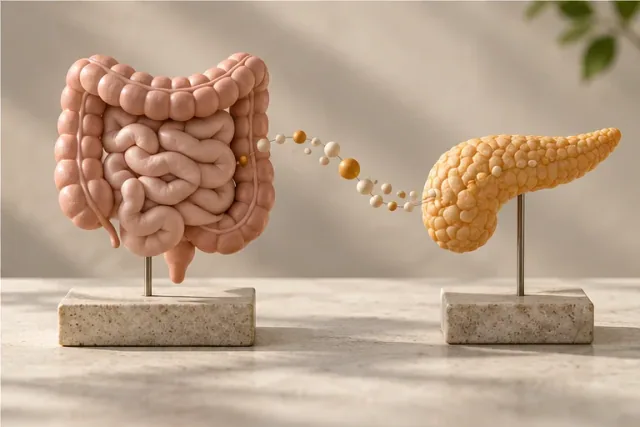
GLP-1 is a 30-amino-acid peptide hormone produced by differential processing of the proglucagon gene in the enteroendocrine “L cells” on the inner surface of the small intestine. It is released when food is eaten; the same gene is also expressed in the brain. [1] Its name comes from deriving from the same precursor molecule (proglucagon) as the pancreatic hormone glucagon; however, unlike glucagon, its effect is toward lowering blood sugar.
The main effects of GLP-1 are summarized in Holst’s review as follows: [1]
- Insulin: Stimulates insulin secretion from the pancreas. Because of this effect, it is an “incretin” hormone (below).
- Glucagon: Suppresses secretion of glucagon, the hormone that raises blood sugar. The first two effects together limit the fluctuation of blood sugar after a meal.
- Stomach and gut: Slows gastrointestinal movement and secretions; for this reason it is considered part of the “ileal brake” mechanism that slows the passage of food through the small intestine.
- Appetite: Appears to be one of the physiological regulators of appetite and food intake.
The same review discusses as a possibility that a decrease in GLP-1 secretion may contribute to the development of obesity, and that excessive secretion may be responsible for postprandial reactive hypoglycemia. [1]
What is the incretin effect?
When the same amount of glucose is taken by mouth, more insulin is secreted than when it is given intravenously. This difference is called the “incretin effect” and is attributed to hormones released from the gut (such as GLP-1 and GIP). The 1986 study by Nauck and colleagues measured this effect: 14 people with type 2 diabetes and 8 healthy people matched for age and weight were given 50 g of oral glucose and intravenous glucose producing the same blood sugar curve. The contribution of the incretin effect to the total insulin response was found to be 72.8% in healthy controls and 36.0% in people with type 2 diabetes. [2]
This finding suggested that the incretin system is weakened in type 2 diabetes and that drugs strengthening this system could be a treatment route. The study is a physiology study of 22 people. The GIP response measured in the same study did not differ between the two groups. [2]
Why does GLP-1 live so briefly in the body?
GLP-1 is broken down very rapidly by the enzyme dipeptidyl peptidase-4 (DPP-4). In the 1995 study by Deacon, Johnsen, and Holst, human plasma in the laboratory (37 °C) converted GLP-1 into an inactive fragment, GLP-1(9-36)amide, by cutting two amino acids from its end; the half-life of this process was 20.4 minutes, and DPP-4 inhibitors completely blocked this conversion. In the same study, the level of this inactive fragment in humans was about 53.5% of intact GLP-1 when fasting and rose to 130.8% one hour after a meal. [3]
According to Holst’s review, GLP-1 is largely broken down before it even leaves the gut; this suggests that some of the hormone’s effects may be transmitted through sensory nerves in the gut and liver. [1] The half-life of native GLP-1 in humans is 1.5 minutes when given intravenously and 1.5 hours when given subcutaneously; this short duration limited use of the hormone itself as a drug. [4] The concept of half-life is detailed in the What does half-life mean? guide.
Detailed guideWhat does half-life mean? Steady state, dosing interval, and washout timeHow were GLP-1 drugs developed?
The problem was clear: the hormone worked but was broken down within minutes. Two solution routes emerged.
Exendin-4: A clue from Gila monster venom
In 1992, Eng and colleagues isolated a 39-amino-acid peptide from the venom of the Gila monster (Heloderma suspectum), a venomous lizard, and named it exendin-4. [5] Exendin-4 shares 53% similarity with human GLP-1. The main difference is a single amino acid at the second position of its sequence (alanine in GLP-1, glycine in exendin-4); this difference makes it resistant to DPP-4 breakdown and extends its intravenous half-life to about 30 minutes. [4] Some pharmaceutical companies based GLP-1 therapy development on the exendin-4 peptide. [4] The synthetic form of exendin-4 is exenatide; it is licensed in Türkiye under the name Byetta. [7]
Analogs starting from human GLP-1
The other route was to modify human GLP-1. The developers of liraglutide and semaglutide added fatty acid chains to the human GLP-1 sequence so that the molecule binds reversibly to the albumin protein in the blood; this protected the peptide both from DPP-4 and from filtration in the kidney. [4] Other companies permanently attached GLP-1 or exendin-based molecules to albumin (albiglutide) or to an antibody fragment (dulaglutide). [4] Two authors of this review are employees and shareholders of the company that developed and markets liraglutide and semaglutide. [4] These engineering solutions allowed drugs administered twice a day, once a day, and once a week to emerge.
What is the difference between GLP-1 agonists and DPP-4 inhibitors?
There are two drug groups based on the incretin system. The 2006 review by Drucker and Nauck distinguishes them as follows: [6]
| Feature | GLP-1 receptor agonists (“incretin mimetics”) | DPP-4 inhibitors (“incretin enhancers”) |
|---|---|---|
| How does it work? | Breakdown-resistant molecules stimulate the GLP-1 receptor directly | Stops the enzyme that breaks down the body’s own GLP-1 |
| Administration (as of 2006) | Injection | Tablet by mouth |
| Effect on HbA1c | 1–2% reduction | 0.5–1.0% reduction |
| Weight | Associated with 2–5 kg weight loss | No weight gain |
| Most common side effect | Mild nausea; decreases over time | Few side effects |
This comparison is based on the drugs of 2006 (exenatide, liraglutide; sitagliptin, vildagliptin). [6] The effects of the weekly drugs developed later are not the same as these figures; the current comparison is on the GLP-1 agonists page. The same review wrote that long-term clinical trials were needed to determine the long-term benefits of targeting the incretin axis; these trials were conducted later and their results are described in the relevant drug guides.
Which GLP-1 drugs are licensed in Türkiye?
TİTCK’s (Turkish Medicines and Medical Devices Agency) Licensed Human Medicinal Products List dated October 16, 2026 includes products containing the following active substances: exenatide (Byetta), liraglutide (Victoza, Saxenda), dulaglutide (Trulicity), semaglutide (Ozempic and Wegovy injection; Rybelsus tablet), and the dual GIP/GLP-1 agonist tirzepatide (Mounjaro). There is no product containing retatrutide or orforglipron on the list. [7] The list also includes fixed combinations with insulin (Xultophy, containing insulin degludec/liraglutide; Soliqua, containing insulin glargine/lixisenatide); Lyxumia, containing lixisenatide alone, is also on the list, but its licence is marked “suspended with justification under Article 23” (“Madde-23 gerekçeli askıda”). [7] Indications, doses, and warnings are in each product’s SmPC (Turkish KÜB); the decision to use belongs to the physician.
Detailed guideGLP-1 agonists: comparison table, major trials, shared side effects Detailed guideSemaglutide (Ozempic, Wegovy, Rybelsus): evidence and safety Detailed guideTirzepatide (Mounjaro): dual GIP/GLP-1 agonist Detailed guideLiraglutide (Saxenda, Victoza): daily GLP-1 receptor agonistCan GLP-1 be increased naturally?
Whether foods increase GLP-1 secretion by stimulating L cells in the gut is a question under investigation; the most studied group is dietary fibers. A 2026 preregistered scoping review collected randomized controlled trials examining the effect of a single, well-defined dietary fiber on blood GLP-1 and satiety in adults: 52 studies in 49 publications with a total of 1,085 participants were included; the median number of participants per study was 19, and 71% of the studies were single-dose (acute) trials. In studies reporting an increase in GLP-1, there was a non-significant trend toward reporting increased satiety (OR 2.95; 95% CI 0.87–9.98). Among the few fiber groups giving consistent results for both GLP-1 and satiety were dextrins. The authors emphasize that the evidence is limited by small samples, short durations, and high heterogeneity. [9]
These findings show that some fibers may briefly change GLP-1 levels after a meal; they do not show long-term weight or blood sugar outcomes. A 2026 narrative review scanning the effects of foods on GLP-1 also states that the physiological effect of changing GLP-1 through diet is modest compared with stimulating the GLP-1 receptor with a drug. [11]
“GLP-1 supplement” and “natural Ozempic” claims
On social media, some supplements are promoted as “natural Ozempic.” A 2026 commentary article writes that berberine is presented, especially on social media, as “nature’s Ozempic”; that this analogy is not a clinically rigorous and evidence-based comparison; and that while semaglutide and other GLP-1 receptor agonists have demonstrated large effects on weight and liver-related outcomes, berberine’s effects are much smaller and inconsistent. [10] Berberine’s drug interactions and evidence are covered in the Berberine guide.
The future of GLP-1 drugs: oral agents and multi-agonists
Development is moving in two directions:
- Oral drugs: The tablet form of semaglutide (Rybelsus) is licensed in Türkiye. [7] Orforglipron, on the other hand, is a non-peptide, orally taken small-molecule GLP-1 receptor agonist. In the 72-week phase 3 ATTAIN-1 trial in adults without diabetes with a BMI ≥30, or 27–30 with a weight-related condition (3,127 people, 9 countries), mean weight change was −7.5%, −8.4%, and −11.2% by dose and −2.1% with placebo; the rate of discontinuing the drug because of side effects was 5.3–10.3% in the orforglipron groups and 2.7% with placebo, and the most common side effects were gastrointestinal. Among the authors are employees of the company that developed the drug. [8] Orforglipron was licensed in the US on April 1, 2026 for weight management; the EMA’s medicines committee gave a positive opinion on October 15, 2026; it is not on TİTCK’s list dated October 16, 2026 (details: Orforglipron).
- Multi-agonists: Tirzepatide stimulates the GIP receptor in addition to the GLP-1 receptor; retatrutide adds the glucagon receptor to this and is at the research stage. Details are in the Tirzepatide and Retatrutide guides.
What the forms of these unlicensed molecules sold online as “for research use” mean is described in the What is a research peptide? guide.
Where to go after this guide?
The shared side effects and major trials of the class are in GLP-1 agonists, warnings specific to semaglutide are on the Ozempic side effects page, and the storage conditions of pens on the label are in the How are peptides stored? guide. The general definition of peptides is covered in What are peptides?, their types in Types of peptides, legal status in Are peptides legal?, and side effects in Peptide side effects. This guide does not recommend drug selection or doses.
Frequently asked questions
What is GLP-1?
GLP-1 (glucagon-like peptide-1) is a 30-amino-acid hormone released from L cells in the small intestine after a meal. It stimulates insulin secretion, suppresses glucagon secretion, slows gastrointestinal movement, and contributes to regulating appetite and food intake.
What does GLP-1 do?
Its main job is to limit the rise in blood sugar after a meal: it increases glucose-dependent insulin secretion and suppresses glucagon. By slowing gastric emptying and affecting appetite, it also contributes to regulating food intake.
Which are the GLP-1 drugs?
The TİTCK (Turkish Medicines and Medical Devices Agency) list dated October 16, 2026 includes products containing exenatide (Byetta), liraglutide (Victoza, Saxenda), dulaglutide (Trulicity), semaglutide (Ozempic, Wegovy, Rybelsus), and the dual GIP/GLP-1 agonist tirzepatide (Mounjaro). Retatrutide and orforglipron are not on this list.
Can GLP-1 be increased naturally?
Some types of fiber have increased GLP-1 secretion in short-term studies; however, in a review covering 52 studies, the studies were small and mostly single-meal. According to another review, the effect achieved through diet is modest compared with stimulating the GLP-1 receptor with a drug.
What is the difference between a DPP-4 inhibitor and a GLP-1 agonist?
DPP-4 inhibitors (tablets taken by mouth) slow the breakdown of the body’s own GLP-1; GLP-1 receptor agonists are breakdown-resistant molecules that stimulate the receptor directly. According to the review by Drucker and Nauck, agonists lower HbA1c by 1–2% and are associated with 2–5 kg of weight loss, whereas DPP-4 inhibitors lower HbA1c by 0.5–1.0% and do not increase weight.
Sources
- Guideline / review Holst JJ — The physiology of glucagon-like peptide 1 (Physiol Rev) (2007)Back to text ↑
- Human study Nauck M, Stöckmann F, Ebert R, Creutzfeldt W — Reduced incretin effect in type 2 (non-insulin-dependent) diabetes (Diabetologia) (1986)Back to text ↑
- Human study Deacon CF, Johnsen AH, Holst JJ — Degradation of glucagon-like peptide-1 by human plasma in vitro yields an N-terminally truncated peptide that is a major endogenous metabolite in vivo (J Clin Endocrinol Metab) (1995)Back to text ↑
- Guideline / review Knudsen LB, Lau J — The Discovery and Development of Liraglutide and Semaglutide (Front Endocrinol) (2019)Back to text ↑
- In vitro Eng J et al. — Isolation and characterization of exendin-4, an exendin-3 analogue, from Heloderma suspectum venom (J Biol Chem) (1992)Back to text ↑
- Guideline / review Drucker DJ, Nauck MA — The incretin system: glucagon-like peptide-1 receptor agonists and dipeptidyl peptidase-4 inhibitors in type 2 diabetes (Lancet) (2006)Back to text ↑
- Institution TİTCK — Ruhsatlı Beşeri Tıbbi Ürünler Listesi (16.10.2026) (2026)Back to text ↑
- RCT Wharton S et al. — Orforglipron, an oral small-molecule GLP-1 receptor agonist for obesity treatment (ATTAIN-1; N Engl J Med) (2025)Back to text ↑
- Guideline / review de Jong JCBC et al. — Dietary fibers to boost endogenous GLP-1 secretion and satiety: a scoping review (Front Endocrinol) (2026)Back to text ↑
- Source Nona R, Kalo E — Berberine and metabolic dysfunction-associated steatotic liver disease: hope or hype? (Pharmacol Res Perspect; yorum) (2026)Back to text ↑
- Guideline / review Tkaczenko H et al. — Foods as modulators of GLP-1 secretion (Nutrients; anlatı derlemesi) (2026)Back to text ↑
Method: Institutional clinical guidance and relevant studies were compared. Each finding is presented with its population, outcome, sources and limitations. Independent medical review has not yet been completed.
This content is for information only and is not medical advice. It does not recommend doses, products or vendors. Talk to your clinician before making any health decision.