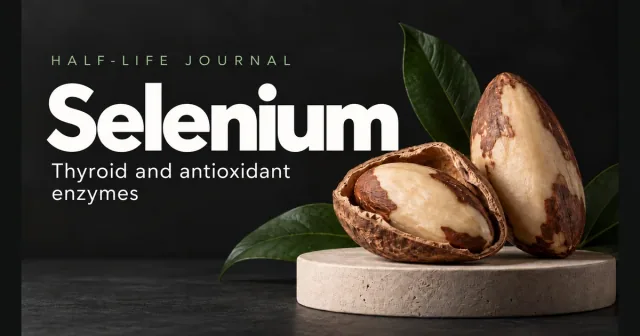
This page is part of: Selenium
Short answer
Selenium deficiency can cause conditions such as Keshan disease in certain regions, and correcting it is beneficial. In people with adequate status, extra selenium has not been shown to prevent cancer, cardiovascular disease or type 2 diabetes; in cancer trials, a harm signal was seen in men with high baseline selenium. In thyroid diseases, a fall in antibodies in Hashimoto’s and a favorable result in mild Graves orbitopathy in a single study have been reported; the size of the clinical benefit is limited. [1] [4] [6] [7]
This page addresses commonly heard claims about selenium one by one. What selenium is, reference intakes, the upper limit and toxicity are covered in the Selenium guide; its relationship with iodine is covered on the Iodine deficiency page.
How are a role in the body and the benefit of a supplement distinguished?
Selenium is a component of 25 human selenoproteins; these function in thyroid hormone metabolism, DNA synthesis and protection against oxidative damage. [1] That a nutrient has such roles does not show that intake above the adequate level will improve these functions. The steps of evidence are separate: a change in a marker in the blood (for example thyroid antibody), an observational association (high selenium status with low risk) and a change in real outcomes in a randomized trial are different questions. Most of the studies below were done in populations with good selenium status; they may therefore not directly reflect the effect in people with deficiency.
What does selenium correct in deficiency?
According to the NIH, selenium deficiency alone rarely causes disease; but in certain populations it can cause conditions such as Keshan disease (endemic cardiomyopathy) and Kashin-Beck disease, and it can also worsen iodine deficiency. In the regions of China where Keshan disease occurred, mean intake was at most 10 µg per day; at least 20 µg/day in adults is stated to be required to protect against the disease. The NIH reports that a 2018 systematic review and meta-analysis of 41 studies reported that selenium supplements reduced the risk of Keshan disease by 86% (doses not stated). [1] This result is for very-low-intake regions; it cannot be carried over to well-nourished populations.
An example from Türkiye recalls this relationship: in a cross-sectional study by Cinaz and colleagues in 847 school-age children in the Ankara region, goiter was found by ultrasound in 107 children (12.6%); goiter was less common in those using iodized salt. Serum selenium in children with goiter was significantly lower than in children without goiter; urinary iodine was also low. The authors suggest that selenium deficiency plays an important role in goiter endemicity. This is an association finding, not cause and effect; the result of selenium supplementation was not tested in this study. [8]
Does selenium supplementation prevent cancer?
SELECT. In this study, 35,533 men received 200 µg per day of selenium (L-selenomethionine), vitamin E, both or placebo; median follow-up was 5.46 years. For prostate cancer, HR 1.04 (99% CI 0.87–1.24) was found in the selenium group; there was also no significant difference in lung, colorectal and overall cancer outcomes. [2]
Analysis by baseline selenium level. In the case-cohort analysis of SELECT (1,739 men with prostate cancer, 3,117 controls), selenium supplementation was ineffective in those with low baseline levels (toenail selenium below the 60th percentile); in those with high baseline levels, it increased the risk of high-grade prostate cancer by 91% (P=0.007). This is a subgroup analysis and not the main result; the authors recommend that men avoid selenium supplementation at doses exceeding the recommended dietary intake. [3]
Cochrane review. The 2018 review by Vinceti and colleagues includes 83 studies; 10 randomized trials had 27,232 participants. In studies at low risk of bias, RR 1.01 (95% CI 0.93–1.10; 3 studies, 19,475 participants; high certainty) was found for any cancer. There was also no significant effect for the most commonly examined cancer types: prostate RR 1.01 (0.90–1.14), colorectal 0.99 (0.69–1.43), lung 1.16 (0.89–1.50). Studies at low risk of bias suggested an increase in melanoma risk. Although cancer risk appeared lower in those with high selenium status in observational cohorts, the NIH reports that the review rated the certainty for these findings as very low. [4] [1]
The observation that “high selenium status is associated with low cancer risk” therefore does not mean that the supplement prevents cancer; no benefit with supplementation was seen in randomized trials.
Does selenium help cardiovascular disease?
The NIH reports that observational studies are conflicting and that the clinical trial evidence does not support reducing cardiovascular disease risk with supplementation, particularly in areas with adequate selenium. In SELECT, cardiovascular events did not change in 17,488 well-nourished men; the Cochrane review of SELECT and 11 small studies (19,715 participants, mostly men) found no reduction in fatal and nonfatal events. [1] The NIH also reports that, in a subcomparison of a meta-analysis, cardiovascular deaths were found to be 23% lower in those taking antioxidant mixtures containing selenium than in those taking mixtures without selenium; this is not a direct placebo comparison, and a selenium effect independent of the other components in the mixture cannot be separated by this analysis. [1]
Does selenium affect the risk of type 2 diabetes?
In a secondary analysis by Stranges and colleagues, 1,202 people without diabetes at baseline, followed in dermatology clinics in the eastern US (regions with low selenium intake), took 200 µg per day of selenium or placebo for a mean of 7.7 years. Type 2 diabetes developed in 58 people in the selenium group and 39 in the placebo group (HR 1.55; 95% CI 1.03–2.33); in the third with the highest baseline plasma selenium, HR was 2.70 (1.30–5.61). Diabetes was a secondary outcome in this study, and diagnoses were based on participants’ reports (confirmed in most). [5] In SELECT, RR 1.07 (99% CI 0.94–1.22; P=0.16) was found for type 2 diabetes in the selenium group; this was not significant. [2] The 2018 Cochrane review also reports a slight increase in type 2 diabetes risk with supplementation in randomized trials. [4] The direction of the two large studies is the same, but only one is statistically significant on its own; the result can be read, only with caution, as “selenium does not prevent diabetes and may be increasing it.”
What can be said about thyroid diseases?
Hashimoto’s thyroiditis. The 2024 meta-analysis by Huwiler and colleagues included 35 unique studies. TPO antibody fell (SMD −0.96; 95% CI −1.36 to −0.56; 29 cohorts, 2,358 participants; I² 90%). In patients not receiving thyroid hormone replacement, TSH also fell (SMD −0.21; −0.43 to −0.02; 7 cohorts, 869 participants). There was no significant change in fT4, fT3, TGAb and thyroid volume; side effects were similar. [6] Another review examining the same question, reported by the NIH (nine studies, 679 participants), saw no effect on TSH, ultrasound findings and quality of life and concluded that the evidence does not support use. [1] A fall in antibodies does not show that the patient’s complaints or disease course have improved; the high heterogeneity also makes the size of the effect uncertain.
Mild Graves orbitopathy. In the study by Marcocci and colleagues, 159 patients with mild orbitopathy received 100 µg of selenium twice a day, pentoxifylline or placebo for 6 months. At month 6, selenium improved quality of life and eye involvement and slowed progression of the disease compared with placebo; exploratory assessments at month 12 confirmed this; no adverse events were seen with selenium. [7] This is a single randomized trial and covers only mild orbitopathy.
Pregnancy. The NIH reports that studies examining selenium supplementation in TPO antibody-positive pregnant women are mixed (in one study postpartum thyroid disorder 28.6% vs 48.6%; in another there was no fall in antibodies) and that in 2017 the American Thyroid Association gave a weak recommendation against selenium supplementation in this group. [1]
Is there evidence for immunity, cognitive function and reproduction?
The NIH reports that in clinical studies in people living with HIV, the effect of selenium supplementation on immune function outcomes was small or absent, and that two Cochrane reviews concluded that there is not enough evidence to determine whether there is benefit. For cognitive function, the NIH writes that clinical evidence does not support supplementation to reduce the risk of cognitive decline and dementia in older adults with adequate selenium status; in male reproduction, some studies have reported improvement in certain aspects of sperm quality and others no effect, and the data are insufficient to determine the effect on fertility. [1] The statement “strengthens immunity” does not match these results.
Evidence summary: result, population and limit
| Claim | Source and population | Finding | Result that should not be generalized |
|---|---|---|---|
| Keshan disease | NIH report: meta-analysis of 41 studies | Risk fell by 86%. [1] | Does not mean benefit in well-nourished people. |
| Cancer prevention | SELECT, 35,533 men; Cochrane, 27,232 participants | HR 1.04; any cancer RR 1.01. [2] [4] | There is a harm signal in men with high baseline selenium. [3] |
| Type 2 diabetes | 1,202 people, 7.7 years | HR 1.55 (1.03–2.33). [5] | Not the primary outcome; not significant in SELECT. |
| Cardiovascular disease | NIH report: SELECT + 11 studies | No reduction. [1] | Not a result for groups with selenium deficiency. |
| Hashimoto antibodies | 29 cohorts, I² 90% | TPOAb SMD −0.96. [6] | Symptoms or disease course not considered improved. |
| Mild Graves orbitopathy | 159 patients, single RCT | Quality of life and eye involvement improved. [7] | Not a result for moderate-to-severe orbitopathy. |
| Goiter association (Türkiye) | Ankara, 847 children | Lower serum selenium in those with goiter. [8] | Result of supplementation not tested; not cause and effect. |
An expectation of benefit is not separated from the safety assessment
The upper limit for selenium is narrow: according to the NIH the UL in adults is 400 µg/day, according to EFSA 255 µg/day; excess intake causes hair and nail loss. The 200 µg/day doses used in the studies above are a study condition, not a recommendation. [1] This page does not recommend a dose.
Detailed guideWhat is selenium? Reference intakes, upper limit and selenosis Detailed guideWhich foods contain selenium?Frequently asked questions
Does selenium strengthen immunity?
Selenoproteins have a role in immunity; however, according to the NIH, in clinical studies in people living with HIV, the effect of selenium supplementation on immune function outcomes was small or absent. No additional benefit has been shown in healthy people with adequate status.
Does selenium prevent cancer?
It did not in randomized trials: in SELECT, HR 1.04 for prostate cancer in 35,533 men; in the Cochrane review, RR 1.01 for any cancer. In men with high baseline selenium, the risk of high-grade prostate cancer increased.
Does selenium help Hashimoto's?
In the meta-analysis TPO antibody fell, but heterogeneity between studies was high (I² 90%). The fall in antibodies has not been shown to translate into symptoms or disease course; another review reported by the NIH found no effect on TSH and quality of life.
Does selenium cause diabetes?
Not certain. In a 1,202-person study, type 2 diabetes was more frequent with 200 µg per day of selenium (HR 1.55); in SELECT the direction was the same but the difference was not significant (RR 1.07, P=0.16).
Does selenium prevent hair loss?
No evidence in this direction has been reported; the NIH reports hair loss and nail brittleness as the most common signs of chronic selenium excess (selenosis).
Sources
- Guideline / review NIH Office of Dietary Supplements — Selenium: Health Professional Fact Sheet (2025)Back to text ↑
- RCT Effect of selenium and vitamin E on risk of prostate cancer and other cancers: the Selenium and Vitamin E Cancer Prevention Trial (SELECT). (2009)Back to text ↑
- RCT Kristal et al. — Baseline selenium status and effects of selenium and vitamin E supplementation on prostate cancer risk (J Natl Cancer Inst) (2014)Back to text ↑
- Vinceti et al. — Selenium for preventing cancer (Cochrane Database Syst Rev) (2018)Back to text ↑
- RCT Effects of long-term selenium supplementation on the incidence of type 2 diabetes: a randomized trial. (2007)Back to text ↑
- Huwiler et al. — Selenium Supplementation in Patients with Hashimoto Thyroiditis: A Systematic Review and Meta-Analysis of Randomized Clinical Trials (Thyroid) (2024)Back to text ↑
- RCT Selenium and the course of mild Graves' orbitopathy. (2011)Back to text ↑
- Human study Cinaz et al. — Goiter prevalence, serum selenium, and urine iodine status in a previously iodine-deficient area in Turkey (Biol Trace Elem Res) — Ankara bölgesinde okul çağı çocukları (2004)Back to text ↑
Method: Institutional clinical guidance and relevant studies were compared. Each finding is presented with its population, outcome, sources and limitations. Independent medical review has not yet been completed.
Updated
This content is for information only and is not medical advice. It does not recommend doses, products or vendors. Talk to your clinician before making any health decision.