In this guide
Short answer
A peptide is a molecule in which amino acids form a short chain through peptide bonds. According to one review, therapeutic peptides are a drug class made up of ordered amino acids with a molecular weight generally of 500–5,000 Da. [1] Insulin was the first peptide drug; today more than 80 peptide drugs have reached the market worldwide. [2] The same word covers three very different product groups: licensed drugs, peptides in cosmetic and food products, and “research peptides,” most of which have no licence for human use in any country. This guide does not recommend personal products or doses.
Quick facts
- Definition (review)
- Therapeutic peptides: ordered chain of amino acids, molecular weight generally 500–5,000 Da[1]
- US regulation
- A polymer of more than 40 amino acids with a specific sequence is counted as a “protein”[4]
- Peptide drugs on the market
- More than 80 peptide drugs have reached the market worldwide[2]
- Türkiye (TİTCK, October 16, 2026)
- Insulins, GLP-1 receptor agonists, oxytocin, octreotide, teriparatide are licensed; research peptides have no licensed product[5]
What is a peptide?
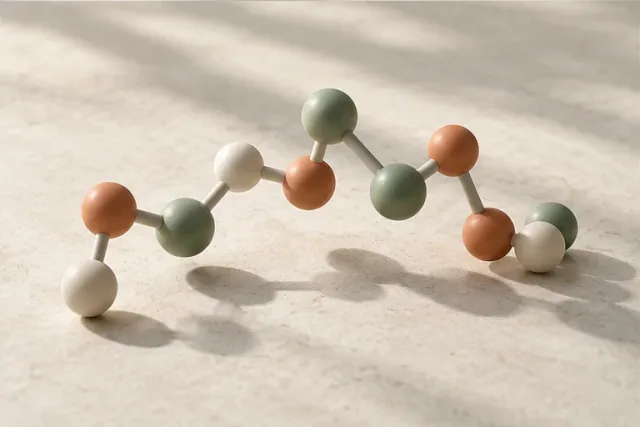
Amino acids are the building blocks of proteins. The bond formed between two amino acids is called a peptide bond; the chain made of amino acids joined by these bonds is a peptide. The 2022 review by Wang and colleagues defines therapeutic peptides as drugs made of a well-ordered amino acid sequence with a molecular weight generally of 500–5,000 Da. [1]
Peptides have two inherent difficulties as drugs: they cross cell membranes poorly and they are unstable in the body. According to the same review, peptides generally cannot cross the cell membrane to reach targets inside the cell; their amide bonds are easily broken down by enzymes in the body, which shortens half-life and speeds excretion. [1] For this reason, most licensed peptide drugs act by binding to receptors on the cell surface, and their structures have been modified to extend half-life. The concept of half-life is explained in the What does half-life mean? guide.
What is the difference between a peptide and a protein?
Both are chains of amino acids; the difference is length and three-dimensional folding. There is no single universal cutoff. US regulations define a polymer of amino acids with a specific sequence and more than 40 amino acids as a “protein”; if there are multiple chains linked together in nature, the total number of amino acids is used. [4] Wang and colleagues, on the other hand, write that chemical synthesis of peptides below 50 amino acids is routine, while large-scale production of longer chains is still difficult. [1] In the same review, insulin is referred to as a 51-amino-acid peptide. [1] So depending on the definition used, insulin can be considered “a large peptide” or “a small protein.”
Which peptides does the body produce?
Peptides are among the body’s basic signaling molecules. According to Wang and colleagues, peptide drug research began with the study of natural human hormones such as insulin, oxytocin, vasopressin, and gonadotropin-releasing hormone (GnRH). [1] The same review describes GLP-1 as a hormone released from L cells in the small intestine that stimulates insulin secretion from the pancreas, suppresses glucagon release, increases the feeling of fullness, and slows gastric emptying; native GLP-1 is rapidly inactivated in the body by the DPP-4 enzyme. [1] Drugs that mimic the effect of this hormone are covered in the What is GLP-1? and GLP-1 agonists guides.
Collagen peptides are different from this group. Collagen is the structural protein of connective tissue; “collagen peptides” sold as supplements are mixtures obtained by breaking down this protein and are not a single molecule acting on a specific receptor. The state of the evidence as a supplement is in the Collagen guide.
History of peptide drugs: from insulin to GLP-1 drugs
The story of insulin is the beginning of peptide drugs. According to Vecchio and colleagues, permission for a trial in humans was granted on 11 January 1922, and the first patient was Leonard Thompson, a 14-year-old with severe diabetes, at Toronto General Hospital; the first injection failed and led to a sterile abscess, and in the second series of administrations on 23 January, blood sugar fell from 520 mg/dL to 120 mg/dL. [3] According to Wang and colleagues, insulin became the first commercial peptide drug in 1923. [1]
In the following decades, synthetic forms of oxytocin and vasopressin and recombinant human insulin were developed. [1] Among peptide drugs approved after 2000, GLP-1 receptor agonists stand out: according to the table by Wang and colleagues, exenatide received its first approval for type 2 diabetes in 2005, liraglutide in 2009, lixisenatide in 2013, dulaglutide in 2014, and semaglutide in 2017. [1] Exenatide was optimized from Gila monster (a lizard species) venom. [1] Muttenthaler and colleagues write that since insulin, more than 80 peptide drugs have reached the market in areas such as diabetes, cancer, osteoporosis, multiple sclerosis, HIV infection, and chronic pain. [2]
How many groups are peptides divided into?
The most useful distinction for the reader is the legal and scientific status of the product. The detailed classification (by function, status, and route of administration) is in the Types of peptides guide.
1. Licensed peptide drugs
These drugs have been evaluated in clinical trials, have received a licence, and have their side effects described in the product information. The table below verifies the licence status in Türkiye from the TİTCK list.
| Active substance (group) | ATC group (code in the list) | TİTCK list, October 16, 2026 |
|---|---|---|
| Semaglutide, liraglutide, dulaglutide, exenatide (GLP-1 receptor agonists) | Blood glucose lowering drugs — GLP-1 analogues (A10BJ) | Licensed products exist |
| Tirzepatide (dual GIP/GLP-1 agonist) | Blood glucose lowering drugs — other (A10BX16) | Licensed products exist |
| Insulins (human insulin, aspart, lispro, glargine, degludec, etc.) | Insulins and analogues (A10A) | Many licensed products |
| Oxytocin | Oxytocin and analogues (H01BB02) | Licensed ampoules exist |
| Octreotide | Somatostatin and analogues (H01CB02) | Licensed products exist |
| Teriparatide | Parathyroid hormones and analogues (H05AA02) | Licensed pens exist |
The licence information in the table is taken from TİTCK’s list dated October 16, 2026. [5] The ATC code shows the pharmacological group of the drug; the approved indication of each product is written in its own Summary of Product Characteristics (SmPC; Turkish KÜB). In Türkiye, Ministry permission is required for placing medicinal preparations on the market and importing them. [9]
2. Cosmetic peptides
In skin-care products, peptides are used as cosmetic ingredients; GHK-Cu (label name “Copper Tripeptide-1”) and palmitoyl peptides are examples. Cosmetic products are applied to the outer surface of the skin; the injectable “research” form of the same substance does not fall within the scope of cosmetics. Details are in the GHK-Cu and GHK-Cu serums and creams guides.
3. Peptides sold as food and supplements
Products such as collagen peptides are sold not as drugs but as food or supplements; they do not go through the same evaluation as licensed peptide drugs. The evidence is evaluated in the Collagen guide.
4. Research peptides
These are substances sold online with a “for research use only, not for human use” label, without sufficient human studies and without a licensed product in Türkiye; most have no human drug licence in any country, and exceptions (for example the Russian registrations of selank and semax) are named in the relevant guides. The FDA had previously placed peptides nominated for compounding drugs in pharmacies, such as BPC-157, CJC-1295, epitalon, MOTS-c, selank, semax, and TB-500, in the category of substances that may present significant safety risks; the nominations for these substances were later withdrawn, and the FDA’s safety assessments remain on the page. For example, on the TB-500 line, the FDA writes about the risk of immune response because of aggregation and peptide-related impurities and that it found no human exposure data. [7] WADA’s 2026 list names BPC-157 in S0, TB-500 in S2.3, CJC-1295 and ipamorelin in S2.2.4, and MOTS-c in S4.4.1 and prohibits all of them at all times. [8] The meaning of the term is in What is a research peptide?, and the legal status is in the Are peptides legal? guide.
Detailed guideWhat is a research peptide? The meaning of the “not for human use” label Detailed guideAre peptides legal? Türkiye, EU, US, and WADAWhy are peptides mostly given by needle?
A peptide taken by mouth is broken down in the stomach and gut by digestive enzymes like other dietary proteins; the part that stays intact also crosses the intestinal wall poorly. Wang and colleagues therefore describe that most peptide drugs are given by injection and that formulation with absorption enhancers, enzyme inhibitors, and hydrogels has been tried for oral use. [1]
The known exception is the oral semaglutide tablet. According to Wang and colleagues, formulating semaglutide with an absorption enhancer called SNAC protects the substance against digestive enzymes in the stomach and facilitates its passage across the stomach lining. [1] Even this solution is limited: according to the EMA’s product information, the bioavailability of semaglutide in the tablet is about 1% at the 3, 7, and 14 mg strengths and up to 2% at the 25 and 50 mg strengths, and absorption is highly variable from person to person. [6] There are no such absorption data for orally taken “research peptide” capsules and drops. How sensitive peptides are to degradation is covered in the How are peptides stored? guide.
How are peptides graded on this site?
In the guides on this site, each outcome row carries a grade: A is strong, B moderate, C weak, D insufficient evidence; E is for “no benefit shown” results. The system is explained on the levels of evidence and methodology pages. For peptides there are two additional rules: a claim based only on an animal or cell study receives D or E, and the field label carries the phrase “not studied in humans”; a single randomized study lowers the upper limit of the grade to C. The effects of licensed GLP-1 drugs shown in large randomized trials can receive a high grade, but the grade applies only to the group of people and the outcome examined in that study. A grade is not a safety approval; side effects are covered separately in the Peptide side effects guide.
Peptide guides on this site
| Guide | Group | In brief |
|---|---|---|
| Semaglutide | Licensed drug | Lowered blood sugar in diabetes and weight in obesity in large RCTs; weight mostly returns after stopping |
| Tirzepatide | Licensed drug | Stimulates the GIP and GLP-1 receptors together; digestive side effects are common |
| Liraglutide | Licensed drug | A GLP-1 drug used by once-daily injection (Victoza, Saxenda) |
| Retatrutide | Drug candidate under investigation | Has phase 3 trials; not licensed anywhere |
| BPC-157 | Research peptide | Findings almost entirely from animal studies; WADA S0 |
| TB-500 | Research peptide | Never studied in humans; WADA S2.3 |
| GHK-Cu | Cosmetic ingredient | Small studies in products applied to the skin; no human data for injection |
| CJC-1295 | Research peptide | GHRH analog; only hormone-level data in humans; WADA S2.2.4 |
| Ipamorelin | Research peptide | Releases growth hormone through the ghrelin receptor; no benefit shown in its only phase 2 trial; WADA S2.2.4 |
| Epitalon | Research peptide | Telomere claims rest on cell and mouse data |
| MOTS-c | Research peptide | Encoded in mitochondrial DNA; efficacy in humans not shown; WADA S4.4.1 |
| Selank / Semax | Registered in Russia, unlicensed in Türkiye | Evidence limited to small studies in Russian, mostly without placebo |
The summary in each row reflects the conclusion of the relevant guide; study designs, limitations, and sources are on those pages.
Detailed guideTypes of peptides: by function, legal status, and route of administration Detailed guidePeptide side effects: licensed drugs and unlicensed productsWhere to go after this guide?
The logic of the GLP-1 hormone and its drugs is in What is GLP-1?, the label language of unlicensed products in What is a research peptide?, the legal framework in Are peptides legal?, and the risks in Peptide side effects. This guide does not recommend personal products, sources, or doses; the use of licensed peptide drugs is a physician’s decision.
Frequently asked questions
What is a peptide, briefly?
A peptide is a molecule formed by amino acids joined by peptide bonds into a short chain. According to one review, the molecular weight of therapeutic peptides is generally between 500 and 5,000 Da; insulin, oxytocin, and GLP-1 are peptide hormones the body produces itself.
What is the difference between a peptide and a protein?
Both are chains of amino acids; the difference is the length of the chain and its folded structure. There is no single universal cutoff: for example, US regulations count polymers of more than 40 amino acids with a specific sequence as proteins; other sources may use different thresholds.
Are peptides drugs?
Some are licensed drugs: insulins, GLP-1 receptor agonists, oxytocin, octreotide, and teriparatide are on the TİTCK (Turkish Medicines and Medical Devices Agency) list of licensed products dated October 16, 2026. Substances sold online as “research peptides,” such as BPC-157 and TB-500, have no licensed product in Türkiye.
Can peptides be taken by mouth?
Most cannot: peptides are broken down by digestive enzymes and cross the intestinal wall poorly. The oral semaglutide tablet is formulated with an absorption enhancer, and according to the EMA its bioavailability is about 1–2%.
Are collagen peptides the same as drug peptides?
No. Collagen peptides are mixtures obtained by breaking down collagen and sold as food or supplements; they are not a single licensed molecule acting on a specific receptor. The state of the evidence is covered in a separate guide.
Sources
- Guideline / review Wang L et al. — Therapeutic peptides: current applications and future directions (Signal Transduct Target Ther) (2022)Back to text ↑
- Guideline / review Muttenthaler M, King GF, Adams DJ, Alewood PF — Trends in peptide drug discovery (Nat Rev Drug Discov) (2021)Back to text ↑
- Guideline / review Vecchio I et al. — The Discovery of Insulin: An Important Milestone in the History of Medicine (Front Endocrinol) (2018)Back to text ↑
- Institution ABD Federal Düzenlemeler Kodu — 21 CFR 600.3(h)(6): protein tanımı (40 amino asitten büyük polimer) (2026)Back to text ↑
- Institution TİTCK — Ruhsatlı Beşeri Tıbbi Ürünler Listesi (16.10.2026) (2026)Back to text ↑
- Institution EMA — Rybelsus (semaglutid tablet): ürün bilgisi (SmPC), bölüm 5.2 (2026)Back to text ↑
- Institution FDA — Certain Bulk Drug Substances for Use in Compounding that May Present Significant Safety Risks (içerik güncelleme tarihi 22.04.2026) (2026)Back to text ↑
- Institution WADA — 2026 Yasaklılar Listesi (Prohibited List; 1 Ocak 2026’dan itibaren geçerli) (2026)Back to text ↑
- Institution 1262 sayılı İspençiyari ve Tıbbi Müstahzarlar Kanunu (mevzuat.gov.tr, güncel metin) (2025)Back to text ↑
Method: Institutional clinical guidance and relevant studies were compared. Each finding is presented with its population, outcome, sources and limitations. Independent medical review has not yet been completed.
This content is for information only and is not medical advice. It does not recommend doses, products or vendors. Talk to your clinician before making any health decision.