At a glance
- Coenzyme Q10 is a fat-soluble molecule produced in the body and taking part in the mitochondrial energy chain; its use as a supplement is a separate question. [1]
- That statin therapy lowers circulating coenzyme Q10 was found in a meta-analysis of 12 RCTs; the effect of the supplement on muscle complaints is conflicting between meta-analyses. [2] [6] [7]
- The strongest result in heart failure comes from a single sponsored study (Q-SYMBIO, 420 people). [3] [4]
- In early Parkinson’s disease, no benefit was shown in the 600-person study. [10]
- This guide does not determine a personal dose.
What is coenzyme Q10, and what does it do in the body?
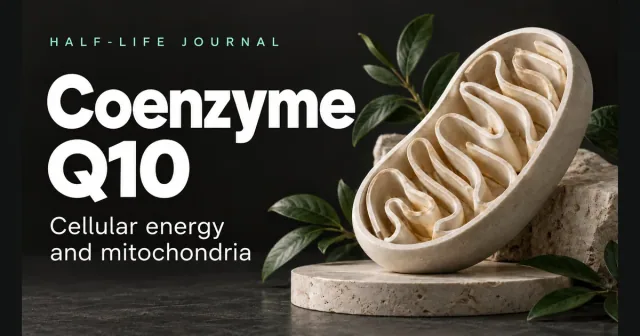
Coenzyme Q (CoQ) is a key component of the electron transport chain in mitochondria and an antioxidant in cell membranes and lipoproteins. It is produced in all cells through an orderly pathway involving a multi-component mitochondrial protein complex. [1] The Cochrane review describes the molecule as a fat-soluble electron carrier. [5]
According to the review by Hernández-Camacho and colleagues, coenzyme Q10 has been found at lower levels in tissues in deficiency syndromes and aging as well as in some chronic diseases; this observation gave rise to the hypothesis that the supplement might ease the signs of aging or delay the onset of these diseases. The review proposes that there is evidence that the supplement favorably affects mitochondrial deficiency syndrome and signs of aging mainly through bioenergetic improvement, and that through its antioxidant effect it eases cardiovascular disease and inflammation; the same review also states that clinical studies with more participants and longer duration are needed for metabolic syndrome, diabetes, neurodegenerative diseases, kidney diseases and fertility. [1] That is, detecting a low level in a tissue does not show that the supplement improves that disease; this is kept separate below throughout as the difference between “role in the body” and “benefit of additional supplementation.”
Does statin use lower coenzyme Q10 levels?
The 2018 meta-analysis by Qu and colleagues pooled 12 randomized studies (1,776 participants) comparing statins with placebo. Statin therapy lowered circulating coenzyme Q10 level (standardized mean difference −2.12; 95% CI −3.40 to −0.84). The decrease was not found to be related to treatment duration; it was seen with both lipophilic and hydrophilic statins and with both low-to-moderate and high-intensity treatment. [2]
This result measures the circulating level; it does not show the level in muscle tissue. The authors interpreted the finding as a possible mechanism for statin-induced muscle complaints; this interpretation does not show that the supplement reduces the complaint. That question is addressed under a separate heading below. [2]
Is coenzyme Q10 found in foods?
The body produces coenzyme Q10 itself; foods are an additional source. In a study in Denmark, the average Danish diet was estimated to contain 3–5 mg of coenzyme Q10 per day, 64% of which came from meat and poultry. In the same study, when healthy volunteers were given a single 30 mg dose either within a meal or as a capsule, serum level rose significantly by both routes; the authors stated that coenzyme Q10 is significantly absorbed from foods. [14] This is an estimate based on one country’s diet and a small single-dose study; it does not reflect intake in Türkiye.
Ubiquinone or ubiquinol?
Two forms are seen in supplements: ubiquinone and ubiquinol; ubiquinol is the reduced form of ubiquinone. In an RCT published in 2026, 150 healthy adults took, for 8 weeks, commercial products at the label dose of ubiquinone, ubiquinol, geranylgeraniol, ubiquinol + geranylgeraniol, or placebo. Ubiquinone, ubiquinol and ubiquinol + geranylgeraniol raised plasma coenzyme Q10 level compared with placebo; there was no significant difference between ubiquinone and ubiquinol (p ≥ 0.15). All costs of the study were covered by a supplement company; the first author is on the same company’s scientific advisory board (according to the paper, the company had no role in design and analysis). [15] This data does not show that one form is clinically superior; the single study measured plasma level, not disease outcomes.
In whom does coenzyme Q10 supplementation work? Evidence summary
| Topic | Condition examined | Limit of the evidence |
|---|---|---|
| Heart failure | Cochrane: 11 RCTs, 1,573 people; Q-SYMBIO: 420 people, 2 years | All studies carry risk of bias; the death outcome rests on a single study; the study was sponsored. [5] [4] |
| Statin muscle complaint | Meta-analysis 1: 6 RCTs, 302 people; meta-analysis 2: 12 RCTs, 575 people | The two meta-analyses gave opposite results. [6] [7] |
| Migraine | 6 RCTs, 371 adults | No significant difference in severity; small studies. [8] |
| Early Parkinson’s | 600 people, phase III RCT | No benefit shown; stopped by futility criterion. [10] |
| Blood pressure, male fertility | Meta-analyses | Details and sources on the sub-page. |
Does coenzyme Q10 work in heart failure?
Q-SYMBIO is a multicenter, double-blind RCT comparing, in 420 people with moderate-to-severe heart failure, 100 mg of coenzyme Q10 three times daily added to standard treatment with placebo over 2 years. There was no significant change in the short-term endpoints at week 16 (NYHA class, 6-minute walk test, NT-proBNP). The long-term primary endpoint, major cardiovascular event, was seen in 15% in the coenzyme Q10 group and 26% in the placebo group (HR 0.50; 95% CI 0.32–0.80). Among the secondary endpoints, all-cause death was 10% versus 18% (p = 0.018). [3]
In the ISRCTN registry, the study’s sponsor is listed as a Danish manufacturer of coenzyme Q10 supplements; the funders are listed as the same company, an Italy-based international coenzyme Q10 association and a Japanese chemical company. [4]
The Cochrane 2021 review covered 11 studies (1,573 participants); all studies had unclear or high risk of bias in one or more domains. The review reported: for all-cause death RR 0.58 (95% CI 0.35–0.95; 1 study, 420 people; moderate-certainty evidence); for hospitalization due to heart failure RR 0.62 (0.49–0.78; 2 studies, 1,061 people; moderate certainty); for left ventricular ejection fraction a mean difference of 1.77 (0.09–3.44; 7 studies; very low certainty); results for exercise capacity, heart attack and stroke are uncertain. No study had examined quality of life with a valid scale. The authors’ conclusion: there is moderate-certainty evidence that coenzyme Q10 probably reduces death and hospitalization; however, there is currently no convincing evidence to support or refute its use in heart failure. [5]
Two details are important in reading these results. First, the death outcome is the data of Q-SYMBIO alone. Second, the 300 mg per day used in Q-SYMBIO is above the 200 mg/day maximum set for food supplements in Türkiye. [13] Treatment of heart failure is run by a physician with standard drugs; the studies examined coenzyme Q10 not in place of these but as a treatment added on top.
Does coenzyme Q10 help statin muscle complaints?
Two meta-analyses examining the same question reached opposite results.
- Banach et al. 2015: 6 RCTs, 302 people using statins. Plasma creatine kinase (CK) activity moved in the direction of an increase with coenzyme Q10 but was not significant (mean difference 11.69 U/L; 95% CI −14.25 to 37.63). There was a trend toward reduced muscle pain but it was not significant (standardized mean difference −0.53; 95% CI −1.33 to 0.28). The authors stated they did not suggest a significant benefit and that larger studies were needed. [6]
- Qu et al. 2018: 12 RCTs, 575 people (294 coenzyme Q10, 281 placebo). A reduction was found in muscle pain (weighted mean difference −1.60; 95% CI −1.75 to −1.44), weakness (−2.28), cramps (−1.78) and fatigue (−1.75); there was no decrease in plasma CK (0.09; −0.06 to 0.24). The authors said coenzyme Q10 could be a complementary approach. [7]
The two analyses were done with different numbers of studies and different pooling methods; both rest on small studies. Which is correct cannot be deduced from these two summaries; the effect is therefore read as “uncertain.” Continuing or changing statin treatment is the physician’s decision. A more recent 2025 meta-analysis (7 RCTs, 389 people) is presented in detail on the sub-page.
Does coenzyme Q10 prevent migraine?
The 2021 meta-analysis by Sazali and colleagues pooled 6 studies (371 participants) comparing coenzyme Q10 with placebo or as add-on treatment in adult migraine patients; crossover designs were excluded. There was no statistically significant reduction in migraine severity. A reduction was found in attack duration (mean difference −0.19; 95% CI −0.27 to −0.11) and attack frequency (mean difference −1.52; 95% CI −2.40 to −0.65). The authors of the meta-analysis reported no conflict of interest; 2 of the 6 included studies had reported funding from drug manufacturers. [8]
The 2012 guideline of the American Academy of Neurology (AAN) and the American Headache Society, reviewing studies between 1999 and 2009, had counted coenzyme Q10 among treatments in the “possibly effective” (Level C) class. However, the AAN board retired this guideline on 16 September 2015 because of serious safety concerns about butterbur, a product recommended in it, and announced that it no longer considered the guideline’s recommendations and conclusions valid. [9] For this reason, the 2012 classification is to be read not as a current recommendation but as historical context.
Did coenzyme Q10 show a slowing effect in Parkinson’s disease?
QE3 was a phase III, double-blind, placebo-controlled study conducted at 67 centers in North America. 600 people who had been diagnosed with Parkinson’s within the past 5 years and did not yet need dopaminergic treatment were randomized to placebo, 1,200 mg per day or 2,400 mg per day of coenzyme Q10; all received 1,200 IU of vitamin E per day. Follow-up was up to 16 months. The prespecified primary outcome was the change in total UPDRS (I–III) score. The study was stopped because the prespecified futility criterion was reached: the mean worsening in UPDRS score was 6.9 in the placebo group, 7.5 in the 1,200 mg group (p = 0.49) and 8.0 in the 2,400 mg group (p = 0.21); that is, the two active groups showed a slight unfavorable trend compared with placebo. The treatment was well tolerated and no safety problem was seen. [10]
Is coenzyme Q10 safe, and does it interact with drugs?
Safety data vary by study. In QE3, doses of up to 2,400 mg/day were well tolerated for up to 16 months. [10] In the Cochrane review, an RR of 0.70 (0.45–1.10; 2 studies, 568 people) was found for adverse event risk; the authors stated there was low-certainty evidence that adverse event risk may increase or make very little difference. [5]
For warfarin there are two different types of data. In the 1998 case report by Landbo and Almdal, a 72-year-old woman taking warfarin was reported to have a reduced response compared with before, and the response to warfarin returned to its former state when coenzyme Q10 was stopped; the authors mentioned the coenzyme’s chemical similarity to vitamin K as a possible explanation. [11] In the crossover RCT by Engelsen and colleagues, 24 outpatients on long-stable warfarin (21 completed the study) were given, in 4-week periods, 100 mg of coenzyme Q10 per day, 100 mg of Ginkgo biloba per day and placebo (with 2-week washouts in between). INR remained stable; the geometric mean weekly warfarin dose was 36.5 mg in the coenzyme Q10 period and 36.0 mg in the placebo period. The authors concluded that coenzyme Q10 did not affect the clinical effect of warfarin. [12] This study is small and short; it examines a single dose level and therefore does not definitively exclude the possibility of interaction.
What questions should be asked when evaluating the supplement?
A decision on a supplement rests not on a single number but on several questions. For what purpose: treatment of a disease such as heart failure or Parkinson’s, statin muscle complaints, or unclear fatigue? Is there a controlled study done for this purpose, and is its result favorable, uncertain or unfavorable? Is the amount used below the supplement limit in Türkiye (200 mg/day for ages 11 and over), or is the amount for which benefit was reported in studies above it? Is a drug such as warfarin being used, is the user pregnant or breastfeeding? [13] [12] Because the answers to these questions vary from person to person, the right step may differ in two people with the same complaint.
What is the status of coenzyme Q10 in Türkiye?
In Türkiye, coenzyme Q10 appears in the Restricted Substances List published by the Ministry of Agriculture and Forestry for dietary supplements. In the list dated 21/09/2026, chemical synthesis is specified as the source; the maximum daily intake is given as 200 mg for ages 11 and over and 100 mg for the 4–10 age group. [13] These limits apply to dietary supplements; some doses used in studies are above this (for example, 300 mg per day in Q-SYMBIO, 1,200–2,400 mg in QE3). The Dietary Supplements Communiqué (Takviye Edici Gıdalar Tebliği) also makes mandatory on the labels of these products the statement “not a medicine” and a warning that a physician should be consulted in case of pregnancy, breastfeeding, illness or medication use. [16] Safety data specific to coenzyme Q10 supplementation during pregnancy and breastfeeding are limited.
Detailed guideWhen to take coenzyme Q10? Fatty meal, split dose and durationThis guide does not recommend a personal dose; in conditions such as heart failure, Parkinson’s, migraine or statin-related muscle complaints, the decision is made together with a physician.
What does the evidence say?
What it does and does not affectLimited or insufficient evidence
- CHeart failure (in addition to standard treatment)Cochrane: reduction in death in a single study (420 people) and in hospitalization in 2 studies, with moderate certainty; according to the authors there is no convincing evidence supporting or refuting its use. The single large RCT was sponsored.
- CStatin muscle complaints — conflictingOne meta-analysis (6 RCTs) found no significant benefit, the other (12 RCTs) found a reduction in pain and weakness; the studies are small.
- CMigraine preventionIn a meta-analysis of 6 studies and 371 people, reduction in attack frequency and duration, no significant difference in severity; the 2012 AAN/AHS had said ‘possibly effective’ (Level C), and the guideline was retired in 2015.
- CBlood pressure — systolic reduction in cardiometabolic patientsIn a meta-analysis of 26 studies and 1,831 people, a reduction in systolic pressure; only cardiometabolic patients were examined.
- DMale fertilityIn the Cochrane review of antioxidant supplements, very low to low certainty evidence; coenzyme Q10 alone was not separated out.
What do the A–E grades mean?
The letter describes the strength of evidence for a specific claim, not the size of the benefit or a usage recommendation. E does not mean ineffectiveness has been proven.
- AStrong
- Established physiology (e.g. correcting a deficiency) or strong, consistent, direct human studies
- BModerate
- Supportive human evidence; small effect or some limitations
- CLimited
- A single randomised trial, mixed results or low-certainty human findings
- DInsufficient
- Small, uncontrolled or indirect evidence; not enough to judge
- ENo benefit shown / not studied in humans
- No benefit shown for the claim, or only animal or cell data exist
These grades are Half-Life Journal’s editorial evidence summary; they are not a formal GRADE rating or independent medical approval.
The letter shows evidence strength; it is not a score for positive effect or a usage recommendation.
Frequently asked questions
What does coenzyme Q10 do?
It is part of energy production in mitochondria in the body and also has an antioxidant role. In which diseases the supplement provides benefit remains unclear: limited evidence based on a single large study in heart failure, conflicting meta-analyses in statin muscle complaints, small studies in migraine; no benefit shown in Parkinson's.
Should people taking statins take coenzyme Q10?
The evidence is not one-directional. A meta-analysis found that statins lower circulating coenzyme Q10 levels; however, of the meta-analyses examining the effect of the supplement on statin-induced muscle complaints, one found no benefit and the other did. Statin use and muscle complaints are evaluated together with a physician.
Does coenzyme Q10 improve heart failure?
The Cochrane 2021 review reported, in 11 studies (1,573 people), all at risk of bias, a possible reduction in death and hospitalization for heart failure with moderate-certainty evidence; the death outcome rests on a single study (Q-SYMBIO). The authors concluded that there is no convincing evidence supporting or refuting its use in heart failure.
Does coenzyme Q10 interact with warfarin?
A case report from Denmark relays reduced response to warfarin that returned to its previous level when the product was stopped. In a crossover RCT in 24 people on stable warfarin, INR and warfarin dose did not change.
Is there an upper limit for coenzyme Q10 supplements in Türkiye?
In the Ministry of Agriculture and Forestry's Restricted Substances List for dietary supplements, the maximum daily intake for coenzyme Q10 is listed as 200 mg for ages 11 and over and 100 mg for ages 4–10 (the list is dated 21/09/2026).
Sources
- Guideline / review Coenzyme Q10 Supplementation in Aging and Disease. (2018)Back to text ↑
- The effect of statin treatment on circulating coenzyme Q10 concentrations: an updated meta-analysis of randomized controlled trials. (2018)Back to text ↑
- RCT The effect of coenzyme Q10 on morbidity and mortality in chronic heart failure: results from Q-SYMBIO: a randomized double-blind trial. (2014)Back to text ↑
- Source ISRCTN Registry — ISRCTN94506234 (Q-SYMBIO kaydı: sponsor ve fon verenler) (2014)Back to text ↑
- Coenzyme Q10 for heart failure. (2021)Back to text ↑
- Effects of coenzyme Q10 on statin-induced myopathy: a meta-analysis of randomized controlled trials. (2015)Back to text ↑
- Effects of Coenzyme Q10 on Statin-Induced Myopathy: An Updated Meta-Analysis of Randomized Controlled Trials. (2018)Back to text ↑
- Coenzyme Q10 supplementation for prophylaxis in adult patients with migraine-a meta-analysis. (2021)Back to text ↑
- Institution Holland et al. — Evidence-based guideline update: NSAIDs and other complementary treatments for episodic migraine prevention in adults (AAN/AHS; AAN tarafından 2015’te emekliye ayrıldı) (2012)Back to text ↑
- RCT A randomized clinical trial of high-dosage coenzyme Q10 in early Parkinson disease: no evidence of benefit. (2014)Back to text ↑
- Human study [Interaction between warfarin and coenzyme Q10]. (1998)Back to text ↑
- RCT [Effect of Coenzyme Q10 and Ginkgo biloba on warfarin dosage in patients on long-term warfarin treatment. A randomized, double-blind, placebo-controlled cross-over trial]. (2003)Back to text ↑
- Institution T.C. Tarım ve Orman Bakanlığı — Takviye Edici Gıdalar Kısıtlı Maddeler Listesi (son güncelleme 21/09/2026) (2026)Back to text ↑
- Human study Coenzyme Q10 in the diet--daily intake and relative bioavailability. (1997)Back to text ↑
- RCT A Randomized, Double-Blind, Placebo-Controlled Trial Comparing the Effects of Commercially Available Ubiquinone, Ubiquinol, and Geranylgeraniol Dietary Supplements on Plasma CoQ10 Concentrations. (2026)Back to text ↑
- Institution Türk Gıda Kodeksi Takviye Edici Gıdalar Tebliği (Tebliğ No: 2013/49), Resmî Gazete 16 Ağustos 2013, sayı 28737 (2013)Back to text ↑
Method: Institutional clinical guidance and relevant studies were compared. Each finding is presented with its population, outcome, sources and limitations. Independent medical review has not yet been completed.
Updated
This content is for information only and is not medical advice. It does not recommend doses, products or vendors. Talk to your clinician before making any health decision.